
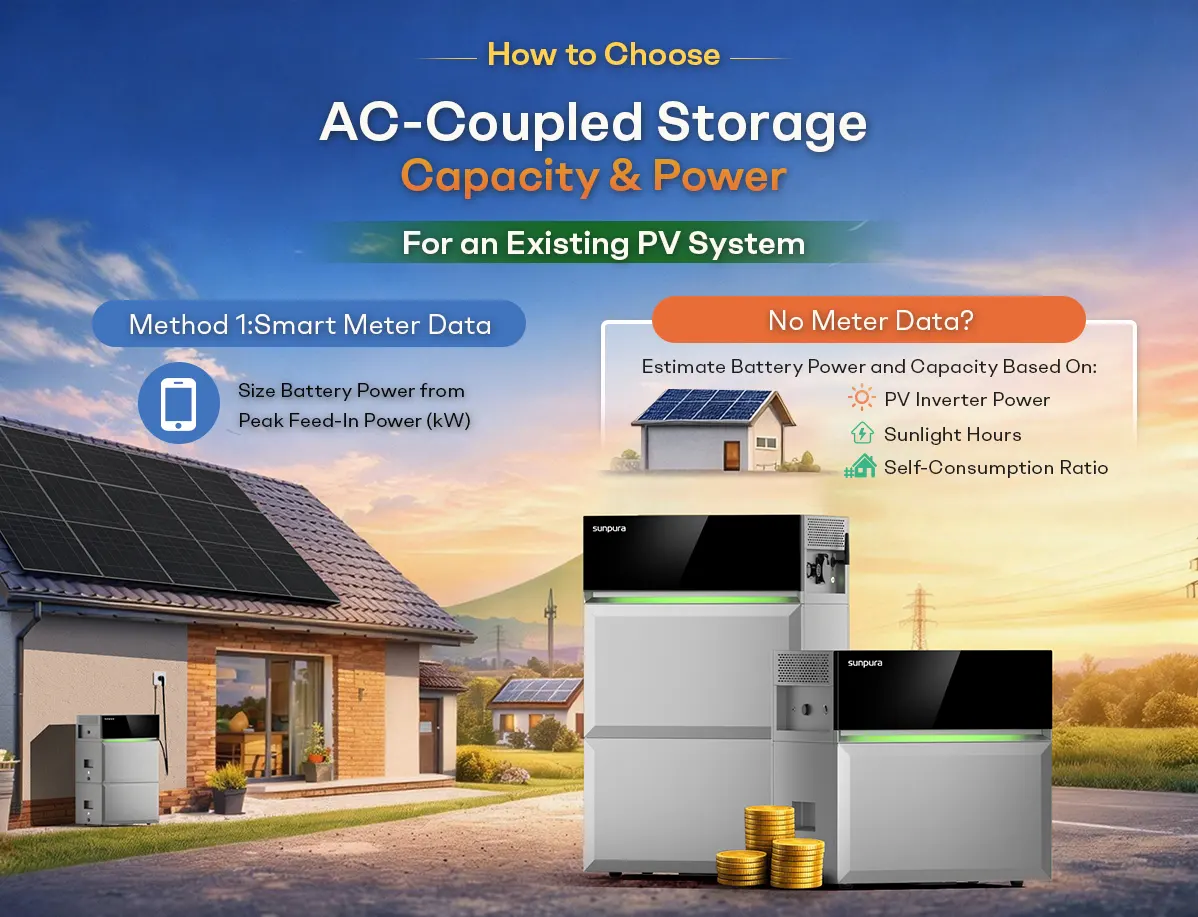
In Germany and the Netherlands, a large number of households have already installed photovoltaic (PV) systems. With rising electricity prices and continuously declining feed-in tariffs, adding a battery storage system is an increasingly popular way to maximize self-consumption of solar energy and reduce electricity costs. However, with various product specifications on the market, such as the frequently searched terms “AC Storage 5 kW” or “AC Storage 10 kW”—how do you choose the right one?
First, it’s essential to clarify a common point of confusion: when people search for “AC Storage 5 kW,” the results typically show 5 kWh (capacity) storage batteries, while kW (kilowatts) refers to power, and kWh (kilowatt-hours) refers to capacity. Understanding the difference between these two parameters is key to selecting a system that truly meets your household’s energy needs.
AC Storage Power (kW) vs Capacity (kWh): Why It Matters
From a hardware perspective, selecting an AC storage system mainly depends on two parameters:
- Power (kW) – how fast the battery can charge and discharge
- Capacity (kWh) – how much energy the battery can store
In simple terms:
- If power is too low, surplus PV energy cannot be absorbed fast enough and will still be fed into the grid
- If capacity is too small, the battery fills up quickly and additional solar energy is wasted
The key question is: How do you know what power and capacity your household really needs?
There are two practical methods.
How to Determine the Right Power and Capacity for an AC Storage System
If you have a smart meter installed, such as a P1 meter or a Shelly meter, you can use real historical data to accurately determine your storage requirements. If no meter data is available, a reliable estimate can still be made based on the rated power of your existing PV inverter.
How to Size Battery Power and Capacity Using Smart Meter Data? The basic logic is simple: The electricity you send to the grideach day represents electricity that could potentiallybe stored in a battery instead.
If You Have a P1 Smart Meter
- Open your P1 meter app
- Switch to Week view
- You will typically see several colored bars: 🟣 Purple – electricity drawn from the grid; 🔵 Blue – PV electricity consumed directly by the household; 🟢 Green – electricity fed back into the grid (the most important one)
The green bars represent the daily feed-in energy and are the key reference for battery capacity.
Best practice: Check several months of data, and then calculate the average daily feed-in energy to avoid looking only at summer (battery capacity may be oversized) or only winter (battery capacity may be too small), and the average value provides a balanced starting point between investment cost and benefit for installing an AC Coupled storage system.
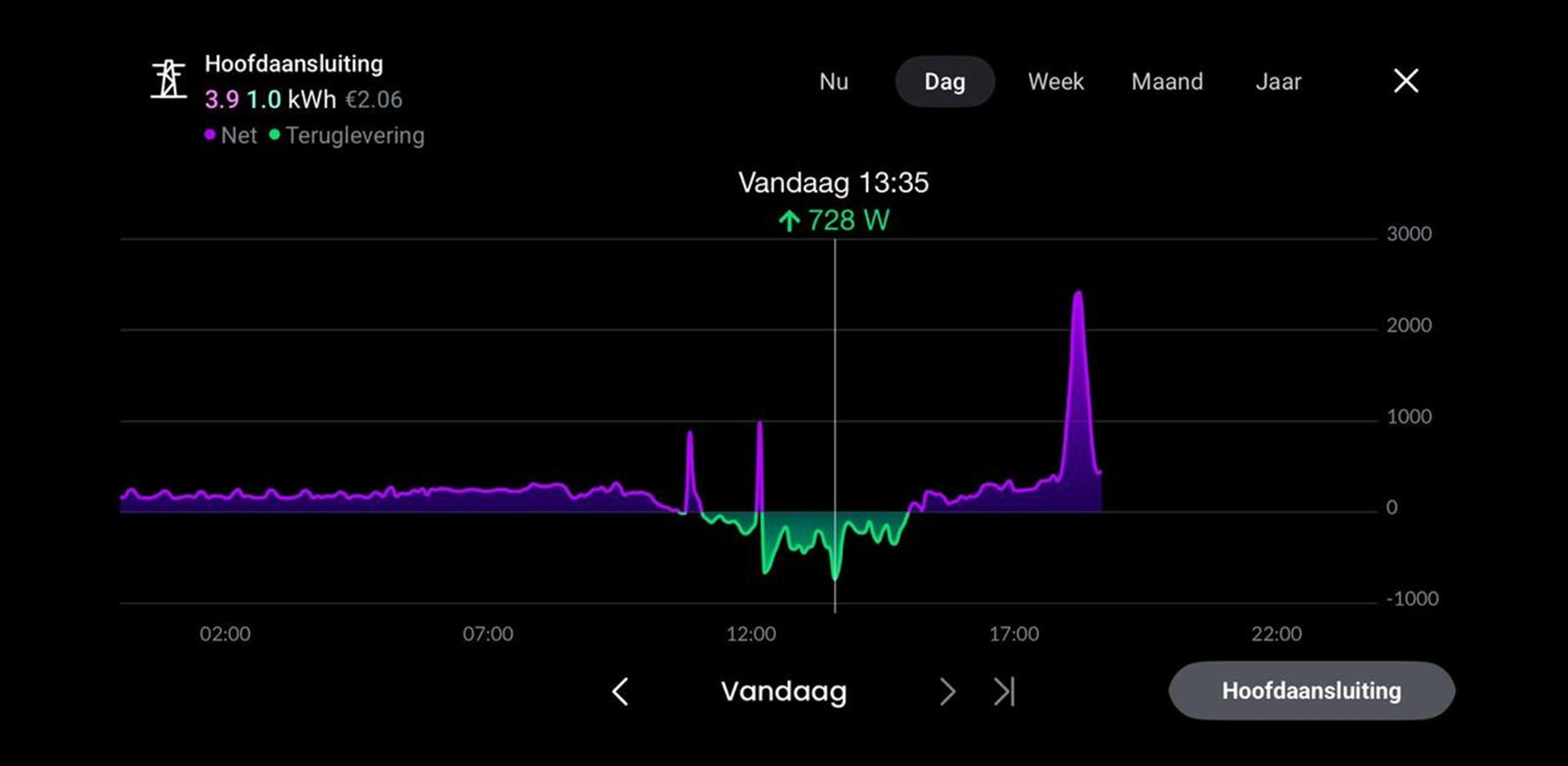
- Determine Battery Power (kW) from Peak Feed-In Power
- Switch the app to Day view
- Check the real-time feed-in power between 13:00 and 14:00, when PV output is usually the highest
- This peak value represents the power your battery should cover most of the time
If your peak feed-in briefly reaches very high values (for example 8 kW for only a few minutes), a 4–5 kW battery is often a more economical choice than sizing the system for rare, short-term peaks.
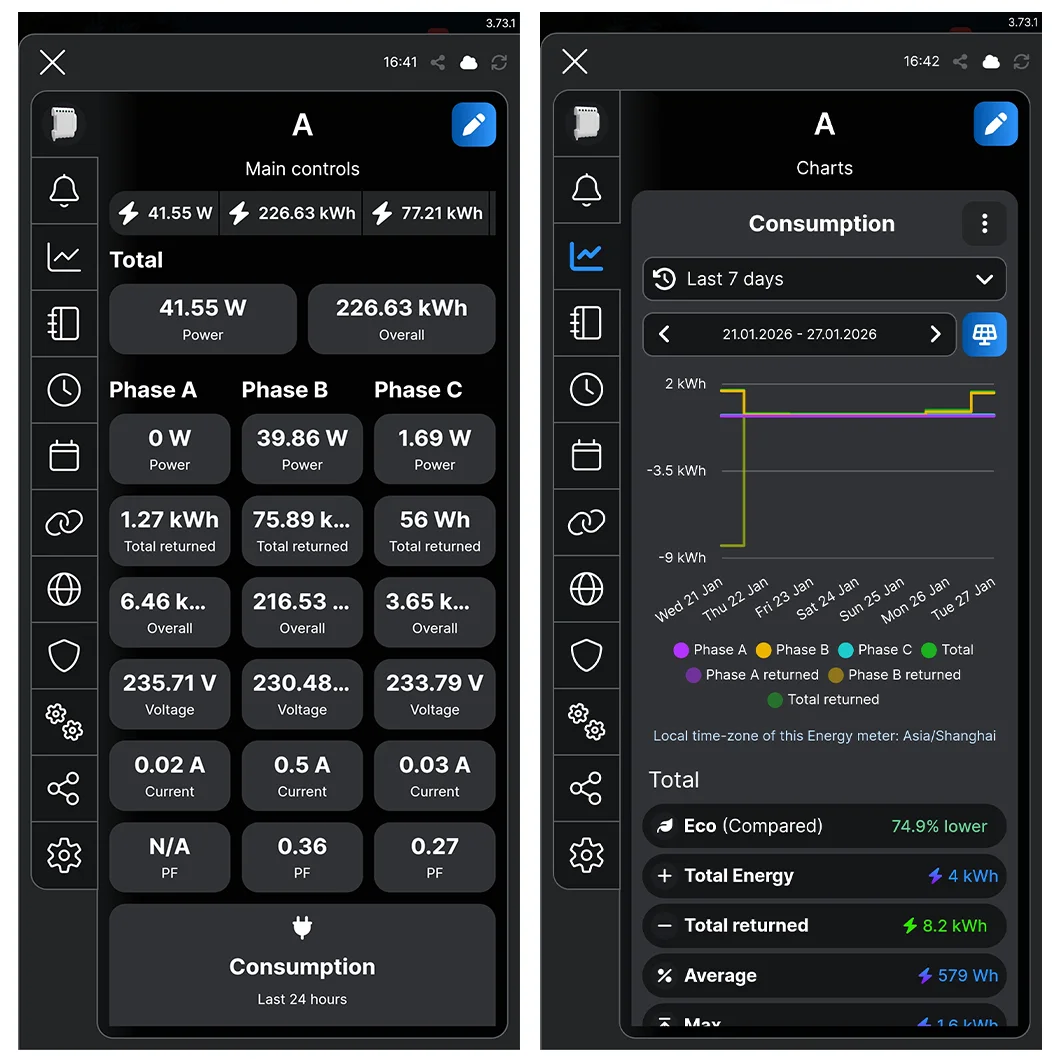
If You Use a Shelly Energy Meter
Battery capacity (kWh):
- Open the Shelly app
- Click the curve/graph icon (The third icon as shown in the picture)
- Select data for the last 7 days
- Check the Total returned fed into the grid
- Calculate the daily average to use this number to estimate the required battery capacity
Battery power (kW):
On a sunny day, check the real-time power value around noon (approximately 13:00–14:00). This is usually when PV output is highest. Your battery’s power rating should be at least equal to this value to avoid limiting your solar generation.
Again, it is recommended to: Review multiple months and use average values to avoid distortion from unusual weather.
How to Estimate AC Storage Size Without Smart Meter Data?
If smart meter data is not available, you can still make a reasonable estimate based on system parameters. The estimation Logic: Battery Capacity ≈ Inverter Power × Effective Sunlight Hours × Self-Consumption Ratio
Assuming an average of 4 effective sunlight hours per day (common in Central Europe) and aiming to store about 50% of your surplus solar energy:
- Example 1: Existing PV inverter power is 5000W (5 kW), with 50% feed-in and 50% self-consumption. → Battery power: around 2.4 kW; capacity: around 4.8 kWh (close to common 5 kWh products).
- Example 2: Inverter power is 8000W (8 kW), with the same 50% self-consumption. → Battery power: around 4.8 kW; capacity: around 9.6–10 kWh (matching common 10 kWh models).
Beyond calculations, your household’s electricity usage pattern also matters:
- If multiple high-power appliances are often used simultaneously in the evening (induction cooker, oven, air conditioning), higher battery power (kW) becomes crucial.
- If your main goal is to store surplus solar energy during the day and use it throughout the night and early morning, larger battery capacity (kWh) should be prioritized.
What Else Matters When Choosing an AC Storage Battery?
Once power and capacity are defined, other factors become equally important.
Battery Efficiency
Round-trip efficiency describes how much of the stored energy can actually be used. High-quality lithium-ion systems, especially those using LiFePO₄ (LFP) cells, typically achieve 90–95% efficiency.
This means: Store 10 kWh → up to 9.5 kWh usable
Lifetime and Warranty
Batteries degrade over time. Typical warranties guarantee: 10 years or a defined number of cycles and the remaining capacity of 60–70% at the end of the warranty period. For example, a 10 kWh battery is guaranteed to still deliver 6–7 kWh after 10 years. This is a key factor when evaluating long-term value.
Future Expandability
Before purchasing, check whether the system supports modular expansion. Some AC storage systems allow you to: Start with 5 kWh and later expand to 10 kWh or more by adding battery modules
This is especially important if you plan to add: an electric vehicle, additional PV panels, a heat pump and etc.
System Compatibility and Energy Management
One major advantage of AC-coupled storage is its broad compatibility with existing PV inverters. For optimal performance, especially when using smart energy strategies (e.g. charging the battery first, then supplying heating systems or EV chargers), choosing a solution with an integrated HEMS (Home Energy Management System) is often the best approach.
Plug-and-Play AC Storage for Existing PV Systems
If you already have a PV system, adding battery storage doesn’t require replacing your inverter or redesigning your system.
Sunpura S2400AC plug-and-play AC-coupled battery solutions are built specifically for households in Germany and the Netherlands:
- Compatible with almost all existing PV inverters
- Simple AC-side installation – no changes to your PV system
- Optimized power and capacity options (5 kWh, 10 kWh and expandable)
- Integrated energy management for smarter self-consumption
Whether you searched for “AC Storage 5 kW” or “AC Storage 10 kW”, the right choice starts with your real energy data — and ends with a storage system that fits seamlessly into your home.
Go for more details about S2400AC by pressing below link.


